Defence
Specialising in underwater acoustics and signal processing, SEMANTIC TS uses sound to infer the properties of the marine environment. We work from upstream studies through to the organisation of survey missions.
Anti-submarine warfare
Mine warfare
Operational oceanography
Seabed classification
Our company regularly works with government services (the Ministry of the Armed Forces and DGA). We are accustomed to handling sensitive or restricted-distribution data.
In theoretical studies, two major families of problems are solved:
- The direct problem: predicting sound distribution (sonar performance).
- Inverse problems: locating the sound source (underwater tracking and positioning), or measuring the characteristics of the marine environment (assessing its impact on sensor performance).
Expertise
- Sonar calibration
- Array directivity
- Signal processing
- Artificial intelligence (deep learning)
- Underwater tracking and positioning
- Underwater telemetry
- Beamforming software
- Ambient and radiated noise measurement and simulation
- Underwater acoustic propagation modelling and real-time underwater communication
- Range prediction
- REA (Rapid Environment Assessment)
- Environmental measurements and databases
- Measurement campaigns at sea: preparation, execution and analysis
- Custom software development
- Signal processing (EVA Lab)
- Software for calculating parachuted payload trajectories
- Other military applications
- Other custom software
Military applications
Examples of dedicated instrumentation developed for military applications involve the following phases:
- Specification and definition of scientific equipment
- Automated measurement chains
- Installation of accelerator cards
- Custom software development
- Inspection and calibration of measurement systems
- Real-time environmental assessment system
- Operational oceanography (TACSI)
- Processing and analysis of measured signals (EVA)
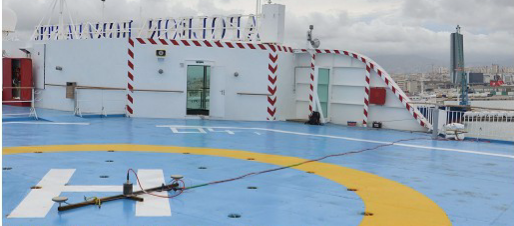
Hull sonar calibration — Franco-Italian HORIZON frigates
Development of the underwater acoustic measurement and monitoring tool. Measurement series performed from 2007 to 2009 for EUROSYSNAV.
French Navy ALHAMBRA project
The ALHAMBRA project concerns the development of radiated-noise measurements using listening submarines. To improve the performance of the point listening system initially installed on submarines, a towed linear array was selected because it has a narrow beam and a better signal-to-noise ratio within that beam. The submarine being measured is acoustically tracked by pointing the array at it.
This technique is effective, offering a useful gain in signal-to-noise ratio, only if the array points precisely at the submarine, the submarine remains within the beam throughout the measurement, and its position is accurately known for analysis.
Principle of the ALHAMBRA radiated-noise measurement system.
Semantic T.S. designed and built the tracking software installed:
- aboard the submarine being measured (S.M.A.M.);
- aboard the measuring submarine (S.M.E.).
The S.M.E. software plots the position of the S.M.A.M. relative to the array in real time using eight distances obtained from a rangefinder.
The S.M.A.M. software determines its position relative to the S.M.E. using distance and azimuth information entered manually.
The system's functions cover the constituent phases of a tracking system:
- Functions:
- Telemetry using matched filtering
- Positioning
- Tracking
- Prediction
- Visualisation
- Synchronisation
- Screen replication at the P.C.N.O. (navigation and operations control station)
- Control of the various instruments: recorder, analogue interfacing, etc.
Our defence references
- SHOM (Navy hydrographic and oceanographic services)
- CMO (military oceanography centre)
- DCNS Brest – DCNS Toulon – DGA – CTSN/DLSM – MRIS
- THALES Safare – ECA – EUROSYSNAV – HORIZON frigates
- DEGREANE – IRENAV – CELAR – CAP – SPART
- NAVAL GROUP – upstream studies
- THALES
- DGA