The DIVA method
The DIVA method: an innovative process for biocenotic surveys
DIVA: Acoustic Vertical Detection & Inspection
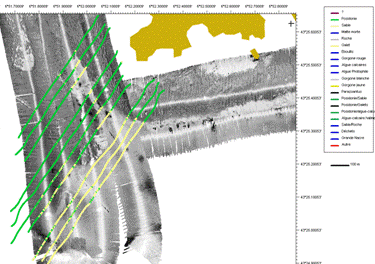
The DIVA SACLAF method is an innovative method developed by SEMANTIC TS to address the mapping of underwater vegetation needed to manage Natura 2000 sites. It uses the shape of the acoustic signal from a single-beam echo sounder to infer information about seabed cover. SEMANTIC TS has a single-beam acoustic sounder on its instrumented vessel that enables this type of operation. This high-end scientific sounder has already been used by INRA teams to characterise fish species in similar work using the acoustic signal reflected by schools of fish.
With the sounder used, the acoustic response differs depending on whether the sound is reflected from an area covered by vegetation or not. The DIVA method uses this phenomenon to locate Posidonia seagrass meadows. It currently distinguishes sandy bottoms from Posidonia well. Its use on dead matte and rock is under study.
The DIVA method is a SACLAF (Acoustic System for Automatic Classification of Seabed Types for Mapping).
Characteristics
- Single-beam acoustic method
- Provides information on the presence of underwater vegetation:
- Posidonia, eelgrass, Cymodocea, kelp and others
- Currently works well for sand and Posidonia
- Accuracy: 1 m at 10 m depth, 3 m at 25 m
- Acquisition rate: 5 per second (overlapping footprints)
- Acquisition speed: 7 knots
- Linear coverage: 100 km/day
Added value
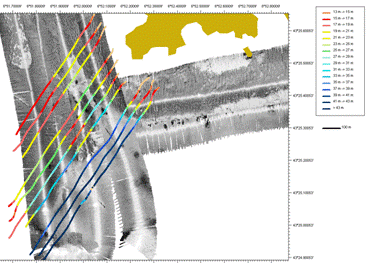
- Provides bathymetry simultaneously
- Works at any depth
- In very shallow water where towed equipment cannot go
- In deep water where sending divers is difficult
- Operated simultaneously with other equipment (sonar, multibeam echo sounder, etc.)
- Works day or night, independently of currents, temperature or water turbidity
- Extremely simple to deploy (as with navigation); no person or equipment needs to enter the water
- Near-real-time processing allows rapid repositioning and survey optimisation
- Information is stored; the repeatable process is useful for monitoring change
- Low deployment cost, with no additional expense alongside a multibeam sounder or side-scan sonar